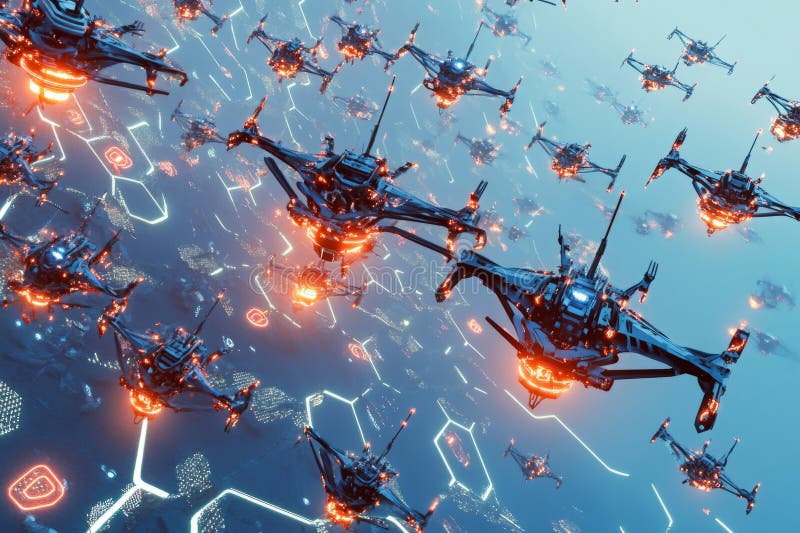
The Battle of Kharkiv Was No Accident—It Was Planned by AI
On April 3, 2026, Ukrainian forces announced the capture of a Russian strongpoint near Kharkiv. What made it historic wasn’t the size of the force engaged—it was the *absence* of human boots on the ground. Instead, a coordinated swarm of first-person view (FPV) drones, loitering munitions, and ground robots conducted surveillance, targeting, and even assault operations without direct human control. According to a CSIS report, this operation was enabled by a newly deployed AI ‘command agent’—a system that fused real-time sensor data from drones, satellites, and ground sensors to generate and execute battle plans with minimal human oversight.
This wasn’t just automation. It was *autonomy*—systems making decisions under uncertainty, adapting to countermeasures, and prioritizing targets based on evolving objectives. The AI agent didn’t just recommend strikes; it *executed* them by sending commands to drone swarms and supervised robotic platforms. Soldiers were present—but largely as observers and decision validators.
What’s shocking isn’t the tech—we’ve seen autonomous drones before. It’s the *scale* and *maturity*. This was a brigade-level operation, not a lab demo. And it signals a turning point: AI isn’t just a force multiplier anymore. It’s becoming the primary *decision-maker* in high-stakes engagements. Commanders still set goals, but the systems now *own* the OODA loop—the Observe-Orient-Decide-Act cycle that defines modern warfare.
Why 8GB GPUs and 16-Core APUs Are the New Frontline of AI Warfare
Parallel to the battlefield, another revolution is brewing in compute architecture—and it’s being driven by the same logic: efficiency over raw power. Intel’s rumored Nova Lake-S APUs with 12 Xe3P iGPU cores and AMD’s Ryzen G-series APUs aren’t just for gamers or creators. They’re designed for *edge autonomy*—AI systems that run on tanks, drones, and robotic mules without needing a data center or even a dedicated GPU.
Here’s the pattern we’re seeing: modern warfare demands AI that’s *small, fast, power-efficient*—and runs in harsh conditions. The same tech that enables an $1,600 Micro RGB TV or a $285 3D printer is now being repurposed for thermal management, vibration tolerance, and power-constrained environments. Nvidia’s Neural Texture Compression (NTC) is another example—shrinking model footprints so that even 8GB GPUs can run LLMs or vision models in real-time.
This is the hardware equivalent of trench warfare: we’re optimizing not for peak benchmarks, but for *survivability*. The lesson for tech leaders? The next big AI breakthrough won’t come from a 1,000-Watt A100 cluster. It’ll come from a sub-50W edge device that can run for 48 hours on a battery—and still outthink a human operator. The battlefield of the future isn’t just connected; it’s *computed at the edge*.
The Ethical and Strategic Earthquake Most Analysts Are Ignoring
The Illinois AI liability bill—a proposal some call 'extreme' and others call 'inevitable'—exposes a gaping chasm between innovation and accountability. Anthropic has come out *against* a bill it calls legally reckless, while OpenAI supports it. Why? Because the bill shifts burden of proof to victims in mass-death or financial collapse scenarios. But here’s what’s being missed: this bill isn’t just about lawsuits. It’s about *strategic deterrence*.
If a military AI makes a catastrophic targeting error, who is liable? The commander? The developer? The AI itself? Current international law has no answer. Ukraine’s drone war isn’t just rewriting the rules of engagement—it’s exposing how quickly legal frameworks collapse under autonomy.
We’re hurtling toward a world where an AI agent can wage a skirmish, escalate a conflict, or misidentify a hospital as a military target—with no clear chain of accountability. The real risk isn’t AI going rogue. It’s AI being *treated as a scapegoat*. And in that vacuum, the next arms race won’t be for faster chips—it’ll be for legal immunity.
Tech leaders, defense contractors, and policymakers need to stop debating ‘AI ethics’ as a thought experiment. The Kharkiv operation proves it’s already happening. The question is: are we building guardrails, or just building excuses?
What Comes Next: The Path to Fully Autonomous Battlefields
The Kharkiv operation was Phase 1: human-supervised autonomy. Phase 2 is likely already live: *swarm-on-swarm* engagements, where AI agents control drones not just in support roles, but as primary combatants. Imagine thousands of micro-drones coordinating via mesh networks, adapting tactics in real-time, and targeting not just troops—but each other.
We’re also seeing early signs of AI-driven *logistics*. FPGAs and edge AI are being used to optimize supply routes, predict equipment failure, and reroute convoys under fire—creating a self-healing, self-optimizing battlefield infrastructure.
But the biggest inflection? *Multi-agent collaboration*. The Traces are Trees paper showed how four LangChain agents delegating tasks can fail in unpredictable ways. Scale that to 50 agents—each controlling a drone, a robot, or a sensor node—and you get a system that’s not just autonomous: it’s *emergent*.
The future isn’t Skynet. It’s a *swarm of swarms*—each node intelligent, each network self-organizing. And the companies that win won’t be the ones with the biggest models. They’ll be the ones that can train, deploy, and *govern* autonomous agents at scale—securely, ethically, and at the edge.
That’s the real frontier. And it’s already here.
By 2028, unmanned systems will conduct 30% of frontline reconnaissance and 15% of direct combat engagements in major conflicts, not through teleoperation, but through AI agents that operate with mission-level autonomy. Cloudflare Mesh and zero-trust identity systems won’t just secure SaaS apps—they’ll secure *autonomous networks* running drone swarms across contested airspace. Meanwhile, hardware innovation will bifurcate: we’ll see $200,000 edge servers for high-fidelity autonomy, and $200 edge modules for disposable drones—both powered by the same neural compression tech seen in Nvidia’s 8GB breakthrough. The biggest tech companies won’t just build AI models—they’ll build *autonomous agents* that can enlist, deploy, and govern other agents at scale. And regulators? They’ll scramble to catch up—not with laws, but with treaties. The Geneva Convention of 2030 won’t be about bullets. It’ll be about *algorithms*.
The drone war isn’t coming. It’s here. And it’s not about replacing soldiers. It’s about rewiring war itself. The next time someone tells you AI is just about chatbots and deepfakes, ask them: have they read the CSIS report on Kharkiv? Because the battlefield doesn’t care about your benchmarks. It only cares about who out-thinks—and out-lives—the enemy. And right now? The machines are learning faster than we are.